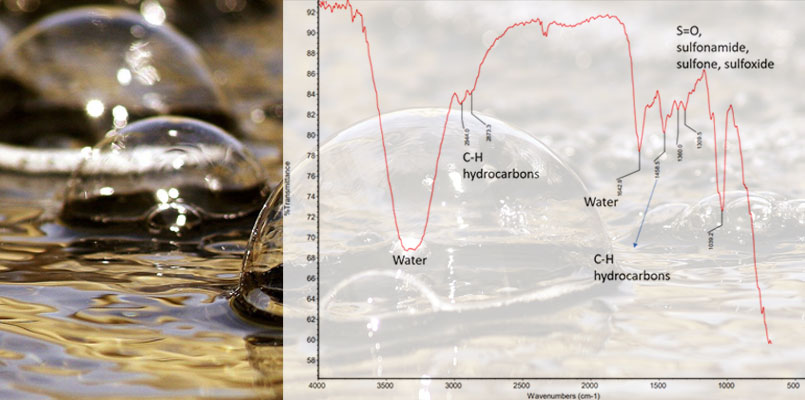
Transmission
Infrared light passes through a thin sample, ideal for particles, fibers and thin films.
An excellent method to find out what an unknown material or contaminant is. Micro FT-IR can analyze an area or material as small as 10 microns.
Polymers, plastics, coatings, powders, residues and liquids can be analyzed to find out a material's chemical properties and composition, and to determine its functional groups.
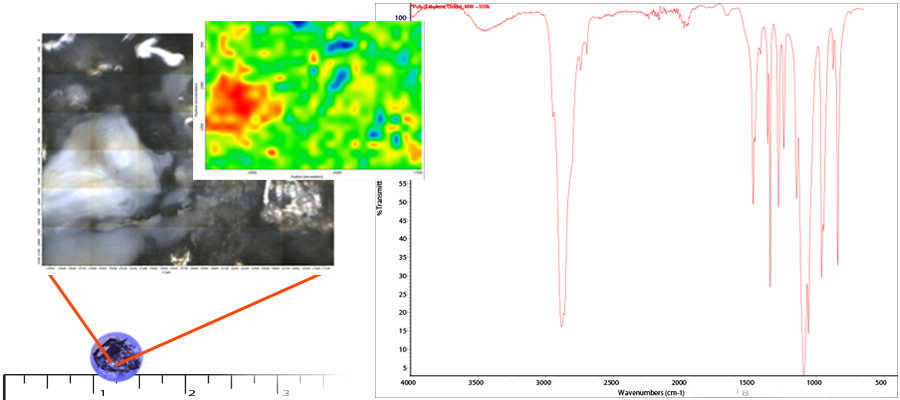

The Fourier Transform is a mathematical process used to convert raw data into a readable spectrum. The data is produced by collecting the light absorbed by the bonds of vibrating molecules, which provides a molecular fingerprint.
An IR beam irradiates the sample over a range of frequencies (4000 cm⁻¹ to 400 cm⁻¹). The sample absorbs this energy at specific frequencies according to its bonds, and the energy is dispersed through vibrational modes. The resulting fingerprint spectrum is then matched against our large library.
A material's composition can be identified using transmission, reflection or ATR modes.
Infrared light passes through a thin sample, ideal for particles, fibers and thin films.
Infrared light reflected from the surface, for coatings and samples on reflective substrates.
Attenuated total reflectance, for liquids, soft materials and surfaces that need little preparation.
Houston Electron Microscopy is equipped with a state-of-the-art Thermo Scientific™ Nicolet™ iN™10 Infrared Microscope. Fourier Transform Infrared Spectroscopy measures the absorption or reflectance of infrared radiation at different wavelengths to produce an infrared spectrum.
SEM & EDS analysis can be paired with micro FT-IR for a more thorough analysis of a material's properties: micro FT-IR provides the molecular structure, while SEM/EDS provides imaging and elemental composition.